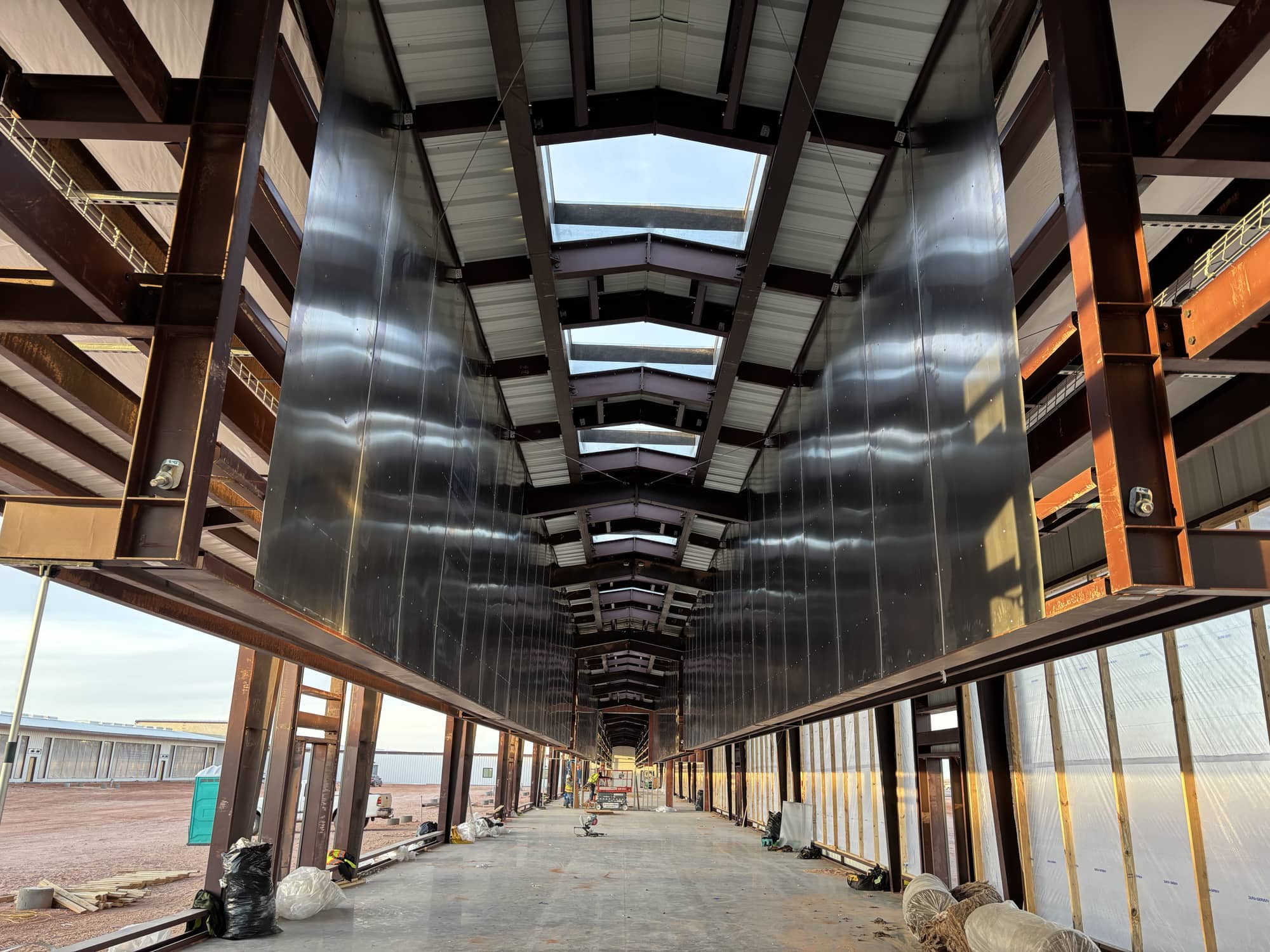
US data center construction has accelerated sharply, and public claims about these projects haven’t kept pace with accuracy. Some describe the buildings as warehouses stacked with computers. Others insist every new facility drains the local water supply, or benefits no one nearby. Many assume every project underway is being built for artificial intelligence, overlooking that the same buildings quietly handle far more familiar work: approving a card payment, syncing a phone backup, streaming a game.
Few of these claims are entirely true or entirely false, and that includes the two loudest ones: that data centers are villains quietly draining the grid dry, and that they’re harmless neighbors with no real footprint at all. Neither is accurate. Data center development sits at the intersection of construction, energy policy and digital infrastructure, fields most people understand only in isolation, which leaves public debate full of partial truths and statistics borrowed from the wrong facility.
For developers, utilities, local officials and construction professionals, getting this right matters, since siting, permitting and community-impact decisions depend on evidence specific to each project, not national narratives. This article works through nine common misconceptions, drawing on federal agencies, national laboratories and engineering standards bodies, to explain what these buildings actually require.
First, what is inside a data center?
From the outside, a data center can resemble any large industrial building: a low-rise shell, minimal windows, modest staff parking. That resemblance ends at the exterior wall.
Server racks, the hardware that processes and stores information, occupy only part of the floor space. Much of the design and cost goes toward keeping that hardware powered and cool without interruption, so that ordinary tasks like a bank transfer, a video call or a hospital pulling up a patient record don’t stall or drop mid-transaction. Utility service enters through dedicated substations and transformers, then through switchgear that distributes electricity through the building. UPS systems and battery banks bridge momentary interruptions, while backup generators cover longer outages; DOE’s best practices guide notes UPS efficiency has climbed from roughly 85-90% in the 1990s to 95% or higher today.
Cooling relies on hot-aisle and cold-aisle containment separating cool intake air from hot exhaust, alongside chilled-water systems, direct expansion units, or increasingly, liquid cooling delivered to the chip. Fire suppression, physical security and building-management systems tracking load, temperature and humidity round out a picture that is deliberately redundant, so a single failure doesn’t take the facility offline, and resembles nothing in a warehouse fit-out.
Myths worth examining
“All data centers are the same” and “every new one is for AI”
Enterprise server rooms, colocation facilities, hyperscale campuses, edge sites and AI-oriented facilities differ substantially in scale, rack density, redundancy and utility needs. A statistic from a hyperscale campus doesn’t describe a small colocation facility down the road.
AI is a genuine driver of new construction, but it’s far from the only thing these buildings do. Tapping a phone to pay at checkout, depositing a check through a banking app, streaming a show, or sending a text all route through data center infrastructure that has nothing to do with training an AI model, work that data centers have quietly handled for decades. The GAO notes that reliable public data separating AI-specific electricity use from other data center activity remains limited. Labeling every new project an “AI data center” overstates what is known.
“All data centers use enormous amounts of water”
Water consumption varies with cooling design, climate and operating practice. Evaporative cooling towers consume water directly on site; air-cooled and closed-loop liquid-cooled systems do not.
Liquid cooling and water consumption are not the same thing. ASHRAE’s guidance on water-cooled servers describes the technology cooling loop running through the racks as typically closed, isolated from the facility water system by heat exchangers. Circulating fluid in a closed loop is not consumption; the method used to ultimately reject that heat, evaporation, air, or a nearby water body, determines on-site demand. It also helps to separate water used directly at the facility, water used to generate its electricity, and water used to manufacture semiconductor equipment. Blending these, or treating withdrawal as equivalent to consumption, overstates the picture.
“Electricity use has always grown at the same rate as digital activity”
Not historically. A 2020 study in Science found that between 2010 and 2018, global data center compute instances rose roughly 550% while energy use grew only about 6%, from an estimated 194 to 205 terawatt-hours. Virtualization and a shift toward efficient hyperscale facilities, hosting 89% of compute instances by 2018 versus 79% in 2010, drove that decoupling. That history is real, but shouldn’t dismiss current growth: AI workloads and high-density GPU hardware are pushing electricity requirements upward faster than the prior decade’s efficiency gains can absorb.
That acceleration is now visible in how some capacity gets built at all: one Texas project contracted in April 2026 calls for a 790-megawatt natural-gas power plant built specifically to run a data center independently of the grid, because regional grid capacity cannot be added fast enough to meet the project’s timeline. It’s a single project, not evidence of an industry-wide pattern, but it illustrates the underlying point: in fast-growing markets, demand is now arriving faster than the grid, or the efficiency gains of the 2010s, can absorb.
“Data centers consume most US electricity”
They don’t, though the share is rising. LBNL’s 2024 report estimated data centers at approximately 4.4% of total US electricity consumption in 2023. Its 2025 update projects this could reach approximately 11.8% by 2030, with a scenario range of 9.5% to 15.3%, a projection, not a measured outcome.
National percentages can also understate local reality: the EIA found that the ten fastest-growing states for commercial electricity demand between 2019 and 2023, led by Virginia and Texas, added 42 billion kilowatt-hours combined, while the other forty states saw demand decline. Inside those concentrated markets, the effective impact far exceeds any national average.
“Data centers are always powered by diesel generators”
Under normal operation, data centers draw power from the grid like any large commercial customer. Backup generators exist for emergencies, and the EPA regulates the turbines and engines used for primary and backup power under Clean Air Act standards, with permitting generally handled by state and local agencies. Some proposed projects are now exploring on-site natural gas generation where grid interconnection is delayed, but that’s a response to local bottlenecks, not the standard model.
“Data centers create huge numbers of permanent jobs” and “they benefit no one locally”
Both miss the mark. Virginia’s Joint Legislative Audit and Review Commission found a 250,000-square-foot facility can require roughly 1,500 construction workers at peak, but only around 50 permanent operating jobs once complete. Statewide, it estimated roughly 59,000 construction jobs against about 15,000 operations jobs annually.
That doesn’t mean no local value is created. Virginia’s sales and use tax exemption for data center equipment saved the industry an estimated $928.6 million in fiscal year 2023, and Loudoun County collected roughly 31% of its local tax revenue from data centers that year, versus about 7% in neighboring Prince William County. The commission also estimated infrastructure costs tied to new demand could add $14 to $37 a month to a typical residential bill by 2040 if left unmanaged. Both benefits and costs are real and depend on the specifics of each jurisdiction.
How data center construction is changing
The sector has moved through distinct phases. In the 2000s, computing capacity spread across thousands of enterprise server rooms, each handling a slice of the email, payroll and file storage that ran ordinary businesses, many running well under capacity. Through the 2010s, virtualization and cloud computing drove consolidation into larger colocation and hyperscale facilities that achieved far higher utilization and efficiency per unit of computing, a trend LBNL documented in its 2016 analysis.
The 2020s introduced AI and GPU-based computing, which concentrate more power and heat into each rack. ASHRAE’s liquid-cooling literature explains the constraint: even top-performing air-cooled facilities deliver only around 1,900 cubic feet per minute per floor tile, while dense modern servers can require 100 cfm or more per rack unit, and fan power that once ran around 2% of server energy has risen to 10-20% in dense configurations. This is driving interest in direct-to-chip liquid cooling, which needs added piping, insulation and specialized labor but can shrink electrical distribution by concentrating load into fewer racks. Air cooling still represents most of the existing US estate; not every facility is being converted to liquid cooling or built for AI.
Site selection now hinges on confirmed grid capacity and interconnection timelines as much as land availability. Substations, transmission lines, large transformers and specialized mechanical equipment all require long lead times and early utility coordination, once dictated mainly by shell-and-core schedules. Commissioning has grown more demanding, since electrical, cooling and control systems must perform correctly together under both normal and failure conditions, not in isolation, and modular, expandable construction increasingly phases capacity to match confirmed power availability.
Why local context matters
None of the figures above should be read as a verdict on any specific project. National statistics describe an industry in aggregate; they don’t describe the capacity of a particular substation or the zoning history of a particular parcel. Grid capacity varies by region and even by feeder line, water availability depends on local hydrology and competing demand, and climate determines how much of the year a facility can rely on free cooling rather than mechanical refrigeration. Zoning, permitting, noise ordinances and tax policy all differ by jurisdiction too; Virginia’s experience shows low-frequency noise can affect residents without violating local ordinances, and a project that is a modest tax contributor in one county can be a dominant share of the local tax base in another, as in Loudoun County. Assessing a proposed data center honestly means examining project- and grid-level realities directly, not conclusions imported from elsewhere.
Conclusion
Data centers are not warehouses, and they are not the villain of the energy transition either. They are specialized, capital-intensive facilities that keep everyday digital life running, from mobile payments to cloud storage to the AI tools now layered on top, and they carry genuine and growing infrastructure requirements, for electricity, water, land and skilled labor, that deserve evaluation on evidence rather than assumption. Historical efficiency gains are real, current AI-driven growth is real, and both belong in the same conversation rather than contradicting one another. Sound decisions depend on project-specific data, not sweeping national claims in either direction.
Successful data center delivery begins with an accurate understanding of the site, its infrastructure and the systems the finished facility will need to support. To discuss the construction requirements of your next energy or industrial project, contact MBA Energy & Industrial.